

0 item(s)
View cart
You have no items in your shopping cart.
Last Updated: September 13, 2026
Enterprise security buyers are rethinking single-vendor camera ecosystems, and the numbers explain why. A 2026 comparative analysis from WCCTech Group's Verkada vs. Avigilon cost study found that a 50-camera cloud subscription deployment can run between $96,000 and $172,000 over five years. That figure lands differently when you realize the hardware is only part of it. At IMRON Corporation, we've watched security directors at multi-site organizations hit the same wall: the cameras work fine, but the licensing renewal, the closed integration list, and the inability to reuse existing access control hardware turn a manageable system into a permanent expense line.
This guide breaks down the Verkada alternatives for enterprise security that actually hold up under scrutiny, with pricing, licensing models, and the migration questions vendors tend to skip.
The core tension is simple. Proprietary all-in-one platforms deliver a clean user experience by controlling every layer, from camera firmware to cloud storage. Open-architecture platforms give up some of that polish in exchange for interoperability, hardware choice, and long-term cost control. Which trade-off wins depends on how many sites you run, how much legacy hardware you're protecting, and whether your CISO will accept a single vendor as a single point of failure.
The features that separate a durable platform from a locked-in one come down to four things: hardware compatibility, analytics depth, deployment flexibility, and licensing structure. Buyers who weight these correctly avoid most of the regret that shows up in year three.
Open architecture means the platform supports third-party cameras, readers, and controllers rather than requiring the vendor's own hardware. This matters because it lets you protect existing investments instead of ripping out working infrastructure. A 2026 market review from HTS on cloud-based security camera options notes that platforms supporting third-party cameras are gaining ground against proprietary hardware-only ecosystems. When you evaluate a system, ask a blunt question: how many of my current cameras and access controllers work without custom development? If the answer requires a professional services quote, that's the real price.
AI analytics has moved from novelty to baseline. According to the Verkada 2026 State of Cloud Physical Security Report, which surveyed 2,741 IT and physical security leaders across 10 markets, 55% of organizations using AI in physical security rely on AI-verified alarm monitoring, and 53% use AI-generated incident summaries. Object detection, real-time alerts, and AI-assisted video investigation reduce the time between an event and a response. The feature to test is where the processing happens: edge processing keeps bandwidth costs down and keeps working when the network doesn't.
Evaluation Criterion |
What to Ask |
Why It Matters |
|---|---|---|
Hardware compatibility |
How many existing cameras/readers work? |
Determines migration cost |
Analytics location |
Edge or cloud processing? |
Bandwidth and resilience |
Deployment model |
Cloud, on-prem, or hybrid? |
Uptime and compliance control |
Licensing |
Perpetual or subscription? |
Five-year TCO |
API access |
Open API and OSDP support? |
Integration and future-proofing |
Total cost of ownership, not sticker price, is where proprietary and open systems diverge most. For organizations that want to keep existing cameras and modernize access control instead, IMRON's UnityIS® platform runs on open hardware. There's no per-door subscription attached to the controller itself.
The honest limitation: open platforms ask more of your integrator upfront. You'll spend time confirming compatibility instead of accepting a bundled quote. That work pays back at renewal.
Unified physical security management is the practice of controlling access, video, intrusion, and visitor systems from one platform rather than separate interfaces. For a 15-building, three-state operation, that consolidation is the difference between one dashboard and four logins, but the login count is the least important part. The value shows up in what the subsystems do for each other.
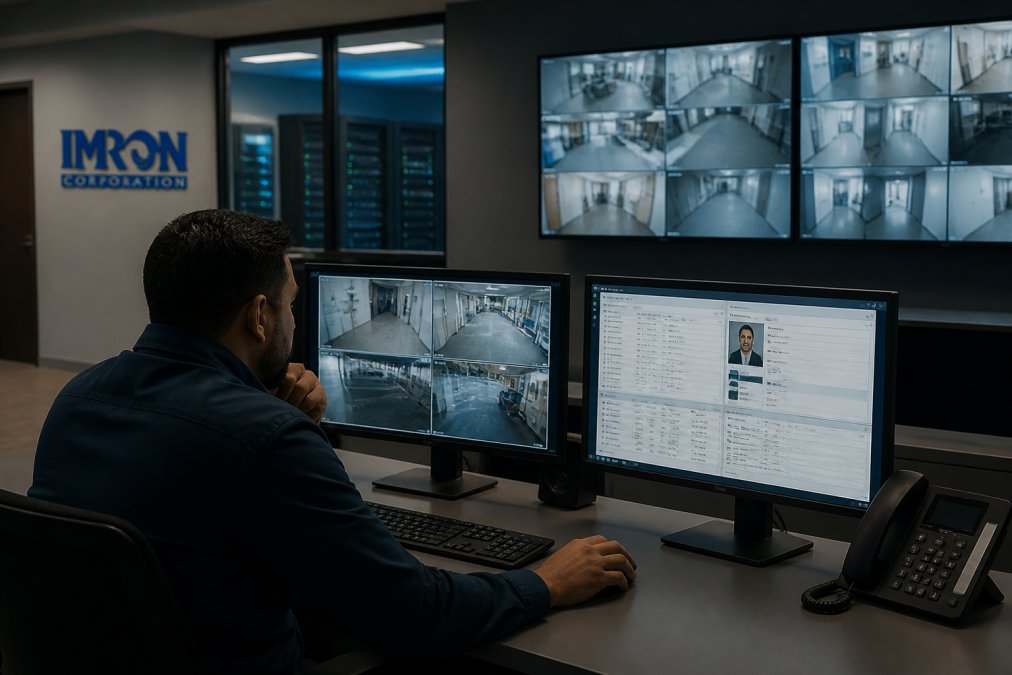
Centralized oversight requires a robust infrastructure that balances signal reliability with installation flexibility when deploying business security cameras across diverse site environments.
A common mistake is assuming "unified" means one login. In practice, test whether the platform shares events across subsystems. Three mechanisms separate genuine integration from a shared front end:
At three states and fifteen buildings, the architecture questions change. Four decisions determine whether the platform scales or buckles:
IMRON's UnityIS® was built for exactly this scenario, managing access control, video, intrusion, visitors, alarms, and building systems from a single platform, deployable in cloud, on-premises, or hybrid environments. The hybrid option matters for critical infrastructure, where a cloud outage shouldn't mean you lose door control.
Open-architecture access control systems accept hardware from multiple manufacturers, so replacing a reader or controller doesn't force a platform migration. Vendor lock-in is a financial risk as much as a technical one, and the financial side is where most buyers get surprised. When one vendor controls both hardware and software, renewal pricing has no competitive ceiling, and the contract terms that make that possible are usually buried in an end-user license agreement nobody reads until year three.
Lock-in rarely announces itself as a single clause. It accumulates across five places in a typical proprietary agreement:
The practical test is credential and protocol support. Look for OSDP rather than Wiegand-only, support for mobile credentials, and controllers that interoperate with pre-wired power systems. OSDP is the modern, encrypted, bidirectional reader protocol; Wiegand is unencrypted and one-directional, which is why OSDP support is the single clearest signal of an open platform. Also verify that the platform publishes an API with documented endpoints, an "open" system with no public API is open in name only.
IMRON's IC2, for instance, uses the same board dimensions and terminal layout as common Mercury LP1502 controllers, so it drops into existing enclosures without re-wiring. For touchless entry, the SAFR SCAN reader at $1,750 runs facial authentication on-device with Wiegand and OSDP output, and the Alcatraz Rock X at $4,345.43 includes five years of cloud service.
The trade-off is real and worth naming. Open platforms push more diligence onto you and your integrator upfront: you confirm compatibility instead of accepting a bundled quote, and you own the integration testing. Proprietary systems hide that work inside a single invoice. The question is not whether you pay for integration, it is whether you pay once, upfront, at a competitive price, or every year at a price the vendor sets alone.
Integration is where most deployments succeed or quietly fail. The difference between a smooth rollout and an 18-month slog usually comes down to documentation and protocol discipline, not hardware quality.
A security integrator who has done this before is worth more than a lower bid. In practice, the integration cost of a proprietary system shows up later as change orders; the integration cost of an open system shows up upfront as due diligence. Budget for the second and you avoid the first.
Migration is the question most comparison guides skip, and it's the one that decides whether a switch is feasible. The good news: you rarely need a full rip-and-replace. A phased migration that keeps existing cameras and access hardware running while you cut over the management layer avoids downtime almost entirely.
Start with a single site or building as a pilot. Run the new platform in parallel with the old one for 30 to 60 days, confirming that access events, video retention, and alarm routing behave as expected. Migrate cardholder data and access rights during a low-traffic window, and keep the legacy system read-only until you've validated a full week of operations. Because open platforms don't require proprietary hardware, the cutover is a software and configuration exercise, not a construction project.
The real risk in 2026 isn't picking the wrong camera. It's signing a multi-year agreement that locks your hardware, your data, and your renewal pricing to one vendor. Enterprises that evaluate Verkada alternatives on total cost of ownership, hardware compatibility, and migration feasibility consistently land on open-architecture platforms that preserve what already works.
IMRON Corporation's UnityIS® was designed for that reality: open by design to integrate best-of-the-line third-party cameras and access hardware, deployable in cloud, on-premises, or hybrid environments, and proven at scale across thousands of sites since 1997. With unified access control, video, and intrusion management on one platform, you modernize without a rip-and-replace.
Explore the platform and see how UnityIS® unifies security across every site you manage.
For organizations seeking unified access control and video with open architecture, IMRON Corporation's UnityIS platform is a strong option.
Open-architecture access control systems let you use third-party cameras, readers, and controllers, avoiding hardware lock-in. This preserves existing investments and reduces long-term licensing fees. For example, IMRON's UnityIS integrates with leading access control hardware and cameras. In contrast, proprietary systems often require you to buy all hardware from one vendor, which can increase total cost of ownership and limit flexibility.
Cloud-based systems offer easier multi-site management and remote access, but can have higher ongoing licensing costs. On-premise systems provide greater control and may be preferred for data sovereignty, but require more IT maintenance. Hybrid deployments combine both.
Prioritize open architecture, integration with existing systems, total cost of ownership, cybersecurity features, and scalability. Ask about licensing models, hardware warranties, and migration support. Also evaluate the vendor's track record and customer references. IMRON Corporation, for example, has nearly three decades of experience and is deployed across thousands of sites.
Yes. Platforms like IMRON's UnityIS are designed to unify access control, video, intrusion, and building systems into one interface. This reduces the need for multiple dashboards and improves situational awareness. When evaluating alternatives, look for API-first architecture and support for common protocols like OSDP. Integration with building automation can streamline operations and reduce training costs.
 IMRON Corporation